Cáceres in 2 days: itinerary to explore the historic center and surroundings
Cáceres in 2 days: see how to organize the historic center, where to eat, when to visit, and what to include if you have extra time.
How to get to Cáceres and get around the city
Getting to Cáceres by train is simple, but it’s worth checking the arrival point on the map before deciding. The train station is outside the historic center, so you will almost always need to complete the journey on foot with a short connection by taxi, car, or urban transport, depending on where you are staying. If the idea is to avoid transfers, the bus is usually the most direct alternative for those who want to get off closer to the central area.
By car, Cáceres works well because the city is compact and getting around the old core is easier on foot than on wheels. This affects the choice of accommodation: parking on the outskirts and continuing on foot is usually more practical than trying to enter the oldest part with the car. For those arriving with luggage or traveling with family, it is worth prioritizing easy road access and confirmed parking at the accommodation.
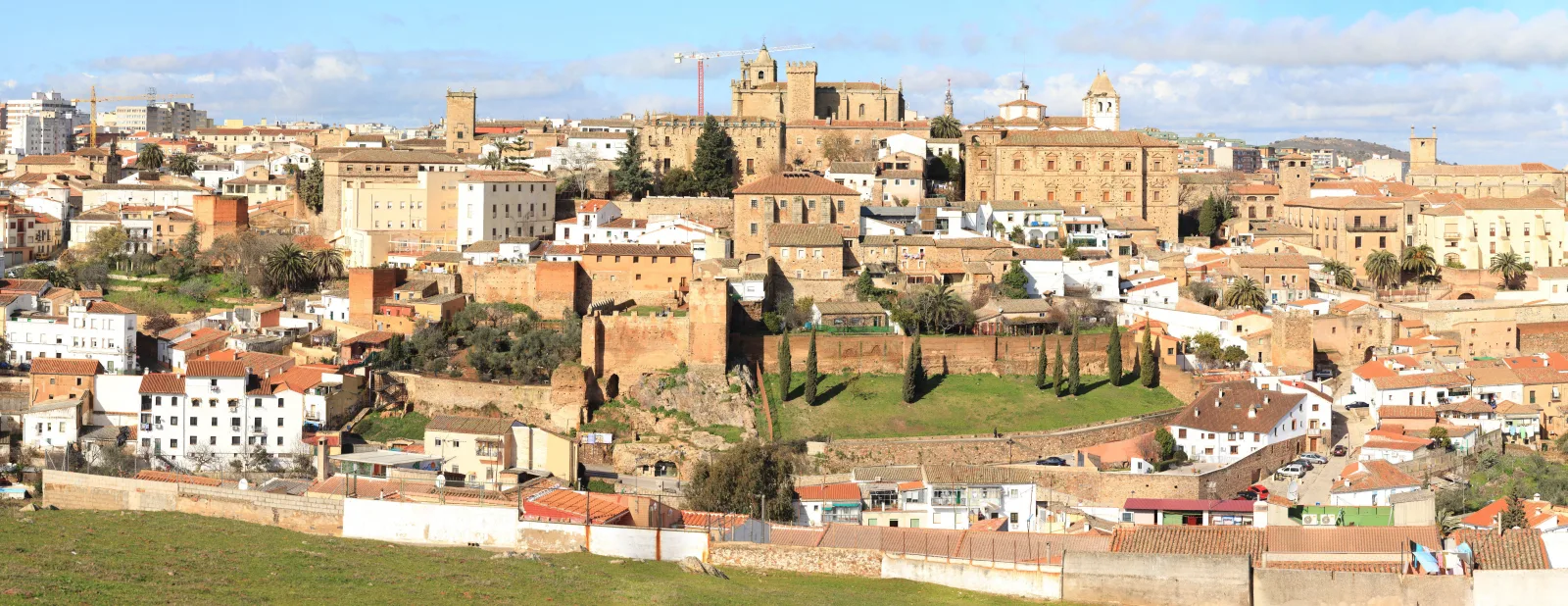
Within the city, the historic center can be explored effortlessly in short walks. Streets, squares, and the main points of the old quarter are close to one another, so walking covers most of the visit. If you are arriving by bus or train, think of the final stretch as a short connection to the center and, after that, as an itinerary that is almost entirely on foot.
Day 1 in the historic center: Plaza Mayor, walls and viewpoints
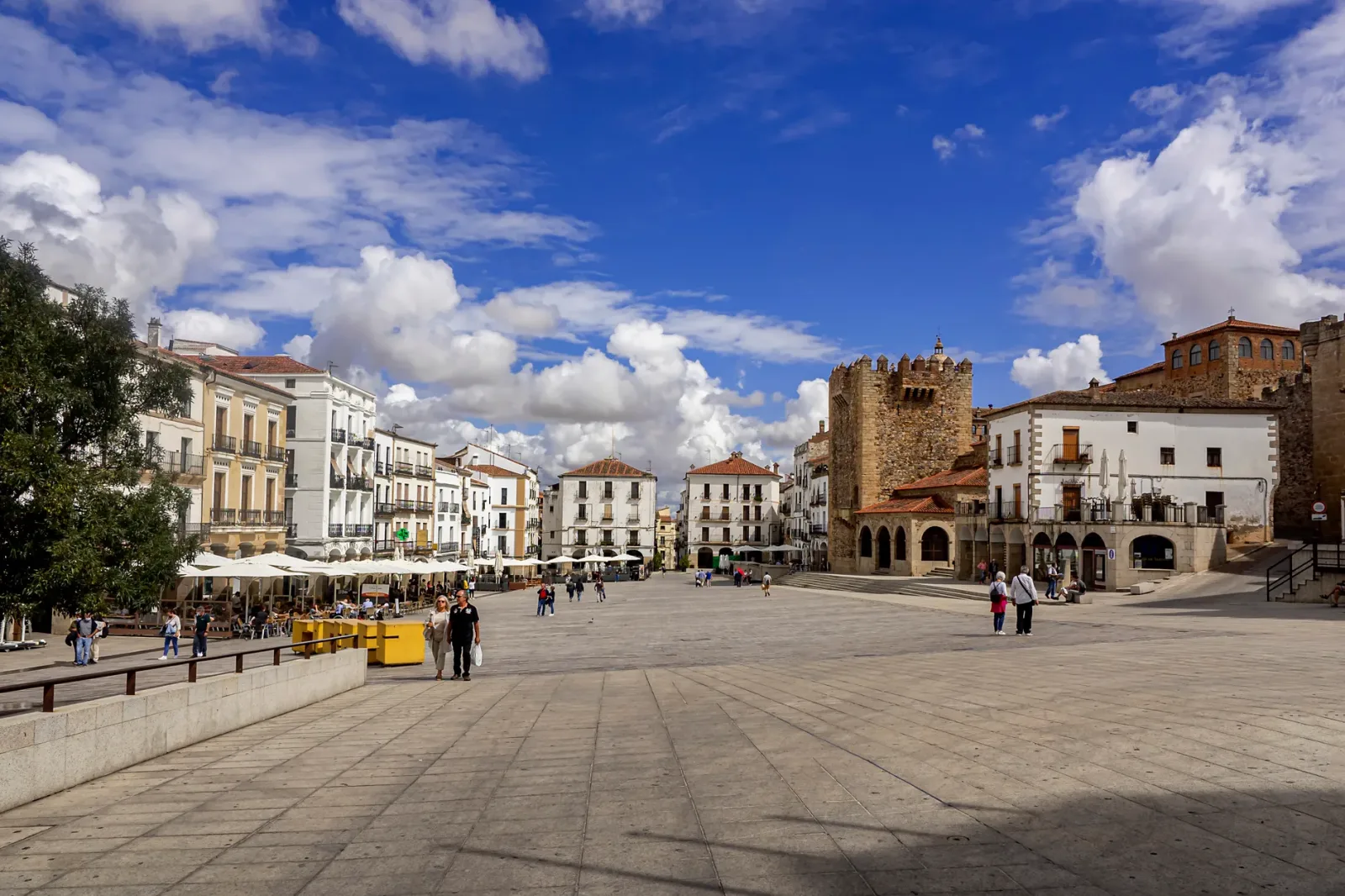
Start at Plaza Mayor and use it as the base of the route. It is from there that it makes sense to explore the historic center without rushing, because the main highlights of this stretch are just a few steps from one another. Torre de Bujaco is the tallest of the group, at 25 meters, and it is worth climbing for the view over the old town; inside, it houses the Interpretation Center of the Three Cultures. Torre de los Púlpitos stands against the wall and is accessed through Torre de Bujaco, so it makes sense to combine the two visits in the same stop.
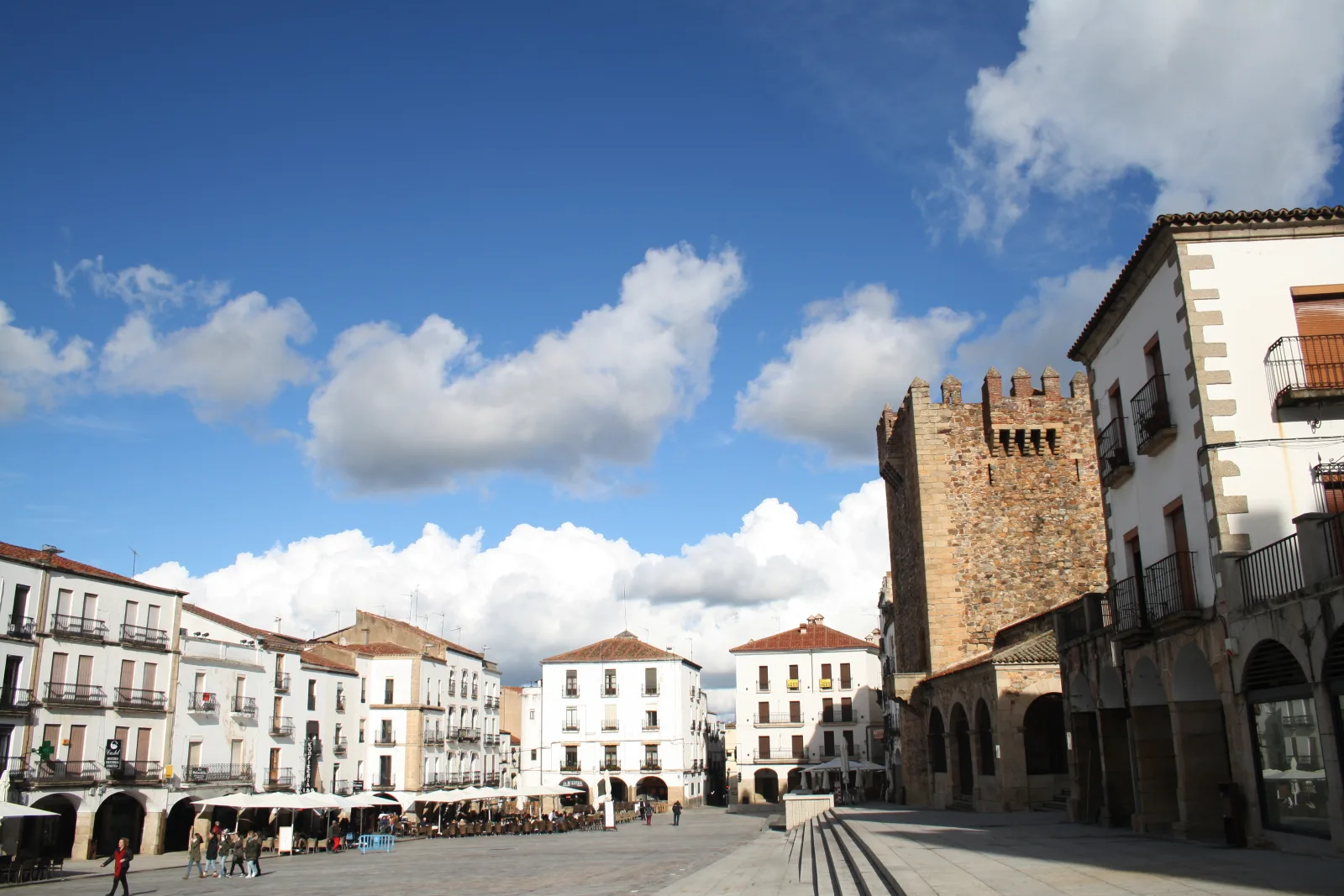
Continue to Torre de Yerba and Arco de la Estrella, which clearly mark the transition between the square and the walled enclosure. The arch is the main gateway into the old city, and from there the layout becomes easier to understand. If you want to enjoy the walk without doubling back, do this stretch in a continuous direction, stopping for the towers before moving on to the narrower passages of the center.
Set aside the next moment for the stretch of wall that can be walked on foot. The walk is short, but enough to see how the fortification encircles the old town and blends in with the towers already seen from below. Access via Torre de Bujaco makes it easy to fit this climb into the morning or late-afternoon pace, when the area is usually more pleasant for walking.
If time remains on the same circuit, return to Plaza Mayor before leaving the area. The ensemble works best when you go through it unhurriedly, alternating high points, walled passages, and the square as an orientation axis.
Editorial transparency: Some links on this page are affiliate links. We may earn a commission at no extra cost to you. This does not influence our recommendations.
Day 2 among squares, palaces, and the co-cathedral
Leave Santa María Square and wander through this ensemble at a leisurely pace, because the buildings are very close together and the visit works better in sequence. The Co-cathedral of Santa María deserves attention first for its Gothic interior and, if it is open when you pass by, for the climb up the bell tower, which gives a broad view of the old center. Right around it, the Episcopal Palace, with parts dating back to the 13th century and later alterations, and the Palace of Hernando de Ovando, with a Renaissance style, help you read the square without having to walk much.
From the same square, head to the Mayoralgo Palace and the Provincial Palace, focusing more on the facades and urban layout than on long visits. The first stands out for its 16th-century facade, rebuilt after the Civil War, and the second preserves its convent origins with a Renaissance portico. If you like seeing interiors, it is worth checking beforehand which of these spaces allow entry on the day of your visit, because that changes frequently.
Then continue the walk to San Jorge Square to close the circuit with fewer back-and-forth trips. There, the church of San Francisco Javier concentrates the most useful stop: a visitable interior and a climb to the viewpoint, which helps you understand the layout of the old quarter. The stairways with the sculpture of Saint George slaying the dragon are along the way and make the natural transition between the square and the church. Before entering, confirm whether access to the viewpoint is open at the time you pass by.
Where to eat and what to try in Cáceres
The food in Cáceres calls for attention to dishes that are part of local everyday life, not to menus designed only for visitors. Torta del Casar appears easily in the city’s bars and on its tables, as do migas cacereñas, jamón ibérico, flores extremeñas, and zorongollo. If you want to taste well without complicating the choice, it is worth noticing what comes most often in sharing portions and what appears as the day’s tapa, because that is how many people eat around there.
The tapa is an important habit in the city. Instead of ordering a large main dish, many people move between bars with small portions accompanying their drink, which helps them try more than one thing on the same outing. For this kind of route, Calle Pizarro is the most traditional area, with bars and restaurants concentrated for tapas and for going out for drinks afterward.
If the idea is to make the right choice, think about the time of day and your appetite. Torta del Casar usually works well with bread and as a starter, migas call for real hunger and are usually served as a more substantial dish, jamón ibérico fits well in simple portions, and zorongollo makes sense when you want something lighter. For dessert, flores extremeñas round things off without weighing you down.
When to visit and how to plan the timing
The best window to visit Cáceres is spring and autumn. In summer, the heat makes long walks and climbs harder; in winter, the cold can make the old town less comfortable for strolling at a relaxed pace. If your trip falls outside these seasons, adjust the pace: take breaks, concentrate your outings during the mildest hours, and leave the open-air stretches for early morning or late afternoon.
Opening hours change frequently, so it is worth confirming everything the day before or on the morning of your visit, especially if you want to enter monuments or climb viewpoints. For interiors, the best strategy is to start early, when there is less chance of finding closed doors or accumulated lines. This makes a difference in Cáceres, because many places work better fitted into the first shift.
After sunset, the old part takes on a different rhythm and becomes more pleasant for strolling without rushing. The lighting and drop in temperature help, especially on hot days, and the street experience changes quite a bit compared to midday. If your itinerary is short, it is worth saving this time for a leisurely walk, leaving the visits with tickets and scheduled times for earlier.
If you are putting together the schedule, think less about the number of stops and more about fitting the timing. A good day in Cáceres usually works like this: interiors in the morning, a walk through the old town when the light is lower, and times confirmed in advance so you do not miss access to anything important.
Where to stay to explore Cáceres with fewer transfers
Staying close to the historic center greatly reduces the need to get around. The city is compact, and that matters more than any other convenience when the idea is to explore Cáceres on foot, go in and out of the old quarter with ease, and return to your accommodation without relying on a car.
If you want to optimize time, look for lodging in the immediate surroundings of the old town. That way, you still maintain quick access to the historic streets, but you usually gain in arrival, departure, and parking. For those traveling with luggage, children, or as a couple and who prefer to avoid long trips at the end of the day, this location tends to work better than staying farther away.
Sleeping outside the center also makes sense if the trip includes outings to the surrounding area. In that case, the accommodation serves as a base for entering and leaving the city with less friction, especially if you are by car and want to simplify logistics. The point to check before booking is very straightforward: how to get to the center, where to park, and whether the return to the accommodation depends on crossing busier areas or narrow streets.
If your priority is to walk less, choose the ring closest to the historic center. If the priority is to use Cáceres as a base to explore the region, it is worth weighing road access and parking ease rather than the exact hotel door.
What to do if you have extra time
If you have half a day or a full day left, it’s worth stepping away from the circuit of squares and palaces and adding a few sights that broaden the visit without complicating logistics. The Centro de Artes Visuais Fundación Helga de Alvear is the clearest option for anyone who wants contemporary art on the itinerary; check the opening hours for the day of your visit, since this type of venue often has variable hours. Parque del Príncipe is a good place for a break in a green area within the city, especially useful if you’re traveling with children or want a pause between two indoor visits.
Outside the center, the most interesting choice is the Reserva Natural de Los Barruecos, where the outing combines granite landscape, lagoons, and water birds. The Museo Vostell Malpartida is in the same area and makes sense together with the reserve, since the two fit well into the same trip. If you have a car, this combination is usually the easiest to organize as a short outing outside the city.
To go beyond Cáceres without turning the trip into a rushed circuit, there are three names that work well as a complement: Monfragüe, for those who want nature and birdwatching; Trujillo, if the idea is another historic town with a striking central square; and Guadalupe, for a longer visit focused on the urban and religious complex. Choose one of them; don’t try to fit all of them into the same day.
If extra time is limited, prioritize what requires less transition and less expectation of opening hours: first art or a park within the city, then a short outing to Los Barruecos and the Museo Vostell Malpartida. Monfragüe, Trujillo, and Guadalupe work better as a day of their own.
Frequently asked questions
How do I get to Cáceres historic center?
The train station is outside the historic center, so you usually need to complete the journey on foot, by taxi, car, or urban transport. The bus is usually the most direct option to get closer to the central area.
Can you explore Cáceres on foot?
Yes. The historic center is compact, and the main sights are close to one another. Walking takes care of most of the visit.
What are the main sights to see in 2 days in Cáceres?
On the first day, it is worth focusing on Plaza Mayor, Torre de Bujaco, Arco de la Estrella, and the walls. On the second, focus on Plaza de Santa María, the Concatedral, the nearby palaces, and Plaza de San Jorge.
Where to eat in Cáceres?
Calle Pizarro is a traditional area for tapas and bars. Among the most mentioned dishes are Torta del Casar, migas cacereñas, jamón ibérico, flores extremeñas, and zorongollo.
What is the best time to visit Cáceres?
Spring and autumn are the best seasons to walk around more comfortably. In summer, the heat makes the climbs and walks harder, and in winter the cold can reduce comfort in the old town.