Rio de Janeiro: what to do, when to go, where to stay, and how to plan your itinerary
Rio de Janeiro: find out when to go, where to stay, and what to do to put together a practical itinerary among beaches, culture, viewpoints, and indoor activities.

How to organize your first trip to Rio de Janeiro
Rio works well for a first trip because it brings together very different experiences in areas that are relatively easy to understand. During the same stay, it’s possible to combine beaches, viewpoints, culture, museums, parks, and nightlife without needing to leave the city’s logic. This helps people traveling as a couple, with family, or alone: the choice is usually not between “seeing Rio” or “not seeing Rio,” but between priorities of beach time, urban sightseeing, nature, or cultural activities.

To decide on the trip, think about the kind of day you want to have. If the idea is to spend more time outdoors, the waterfront, viewpoints, and parks weigh more heavily in the itinerary. If you prefer urban sightseeing, there are the historic center, museums, churches, old buildings, and places for shorter visits. Those who want to spend less find plenty of free or low-cost options; those willing to pay for tickets can focus the trip on more structured attractions and, in some cases, more comfortable options for busy days or for those who don’t want to improvise as much.
The city is also organized into areas with very different profiles for visitors. Zona Sul concentrates the most sought-after beaches and fits a first visit very well. The Centro works better for those who want to fit in culture and architecture. Santa Teresa and Lapa come into play when the priority is street atmosphere, art, and nightlife. Barra da Tijuca and the surroundings of Vidigal usually make more sense for those who want a different relationship with the beach, the view, or local movement. Before putting together any itinerary, it’s worth deciding which of these areas best matches your pace; this avoids crossing the city unnecessarily and helps you choose better what goes into the few days of the trip.
Best time to visit and what to expect from the weather
Rio calls for choosing dates that match the kind of trip you want to take. For those who want the beach, to walk along the waterfront and spend lots of time outdoors, the drier periods tend to help more. Meanwhile, rainy weeks call for more flexibility in the itinerary and work better when you accept alternating between outdoor sightseeing and indoor attractions on the same day.

The heat has a big impact on how the trip is planned. On very hot days, the beach and open areas are more pleasant early or late in the afternoon, when the sun is less intense. Trails, viewpoints and outings that require climbing become harder under strong heat and overcast skies with humidity. If your plan includes this kind of program, it is worth prioritizing stable days and starting early, because the weather changes faster in the forested areas and in the higher parts of the city.
Rain affects a short stay in the city less if you already have some indoor programs in your itinerary. Museums, aquariums, cultural centers, churches and historic spaces help save days of unstable weather. When the sky looks likely to turn, it is worth leaving everything that depends on good visibility for later and fitting in indoor attractions or longer-stay activities. Viewpoints, trails and boat rides are more likely to be canceled or lose their purpose when the forecast worsens.
To choose the right time of year, think about the balance between temperature, chance of rain and the amount of outdoor activities you want to fit in. If the priority is beach, views and walking, look for the driest and warmest window. If you want to mix city and culture without relying so much on the weather, Rio works better with a flexible itinerary, able to swap one open-air activity for an indoor one without ruining the day.
Editorial transparency: Some links on this page are affiliate links. We may earn a commission at no extra cost to you. This does not influence our recommendations.
Where to stay in Rio de Janeiro for each type of trip
Zona Sul usually works best for those who want to wake up near the beaches and move around easily between the seafront, cafés, street commerce, and the city’s classic attractions. For a first stay, it is the most straightforward area for combining beach days with urban outings without relying on long distances. Among the better-known neighborhoods, it tends to give the clearest sense of Rio for those who want to stay close to what usually makes it into the initial itinerary.

Centro, Lapa, and Santa Teresa make more sense when the priority is culture, architecture, and nightlife. Staying in Centro helps shorten access to museums, churches, and historic buildings; Lapa works well for those who want to go out at night and return without hassle; Santa Teresa is for those looking for a more residential pace, with hillside streets, views, and slower travel. For days when the itinerary leans more toward the urban side than the beach, this combination usually saves time.
Barra da Tijuca is better suited to those who want beach space, a more spread-out layout, and a less concentrated routine. It is a useful base for families and for those who prefer wide areas, with less of a cramped feeling than on the more traditional seafront. Meanwhile, the area around Vidigal may appeal to those who want to be close to views and a more local dynamic, but it is worth being careful with the choice of street and accommodation, because the experience changes quite a bit from one spot to another.
If the trip calls for total ease of getting around and many different plans, the safest choice is usually to stay near the Zona Sul or Centro axis. If the focus is nightlife, Lapa is the better option. If the idea is rest with beach time, Barra usually fits better. If the interest lies more in the neighborhood atmosphere and less in pure practicality, Santa Teresa comes into the picture.
How to get around between beaches, viewpoints, and central attractions
Use walking, bicycle, public transportation, ride-hailing, authorized vans, the Corcovado train, moto-taxi, and van in Vidigal according to the type of stretch you will be making. In more concentrated areas, walking works better than depending on a car, because short trips become more predictable and you gain room to stop without setting up heavy logistics. For longer trips or when the heat is intense, bicycles and ride-hailing usually simplify the day, as long as you are willing to depend on traffic.

To get to Christ the Redeemer, the practical options are the authorized vans from Paineiras and the Corcovado train. Both require advance planning because demand is usually high, especially during peak periods. If the priority is fitting in the visit without complicating the rest of the day, it is worth choosing one of these options and booking in advance when possible. In areas with more local circulation, such as Vidigal, the van and moto-taxi can handle short stretches that would be tiring on foot, but this requires extra attention to the boarding point and how the service operates.
For the downtown area and the waterfront, public transportation works best when you want to reduce costs and do not mind adapting the itinerary to the pace of the city. Ride-hailing helps more for trips between neighborhoods or when the goal is to save energy for sightseeing. On days when you want to combine beach, viewpoint, and central attraction, the choice of transportation changes the dead time more than the program itself: the fewer unnecessary transfers, the easier it is to keep the itinerary on track.
The main attractions for a first trip
For a first trip, it’s worth prioritizing the places that help you quickly get a feel for Rio: the postcard landmarks, a beach stretch, a cultural cluster in the Centro, and an easily accessible patch of forest. Christ the Redeemer and Sugarloaf Mountain are included because they offer the clearest view of the city’s geography and are usually the outings that best orient the rest of the itinerary. Between the two, the first works better if you want the classic image of Rio seen from above; the second helps you understand the relationship between sea, coves, and mountains.

Along the beach strip, Copacabana, Ipanema and Arpoador handle the simplest part of the trip: walking, observing local routines, stopping for a swim, and ending the day with a sunset without relying on much planning. Copacabana is usually the most immediate beach to read for first-time visitors; Ipanema tends to attract those who want a promenade more suited to walking and lingering; Arpoador comes in as the transition point between the two, with a view that works well even on a short visit. If you want to feel the city’s rhythm without putting together a complex itinerary, this trio makes sense.
On the historical and cultural axis, the Selarón Steps, the Museum of Tomorrow, the Museum of Art of Rio, the Real Gabinete Português de Leitura and the Monastery of São Bento help balance the trip between architecture, art, and more focused visiting spaces. The Selarón Steps are worthwhile for their visual presence and how easily they fit into the Centro. The Museum of Tomorrow and the MAR work well together in the logic of a more urban outing. The Real Gabinete and the Monastery of São Bento are for those who want to see striking interiors and step a little away from the more obvious circuit without leaving the central area.
For a first stay, Jardim Botânico and Parque Lage come in as the greener, lighter side of the itinerary. The first is ideal for those who want to walk among botanical collections and well-organized visiting areas; the second combines garden, architecture, and a more relaxed pace, useful for fitting in coffee, breaks, and photos without turning the day into a marathon. The Maracanã rounds out the list as a contextual choice: it makes sense for those who want to understand the importance of football in the city or want a different kind of program from the traditional postcard landmarks.
Free and low-cost activities in Rio de Janeiro
To put together a budget-friendly day in Rio, start with the beaches and choose a walking route along the waterfront itself. Spending time in Copacabana, Ipanema, or Arpoador costs little or nothing, and the best use of this part of the day is simple: walk, stop to watch the activity, go for a swim, and end with the sunset. The atmosphere changes depending on the time; in the morning, the beach is better for walking and swimming without rushing, while late in the afternoon it works more as a place to linger.
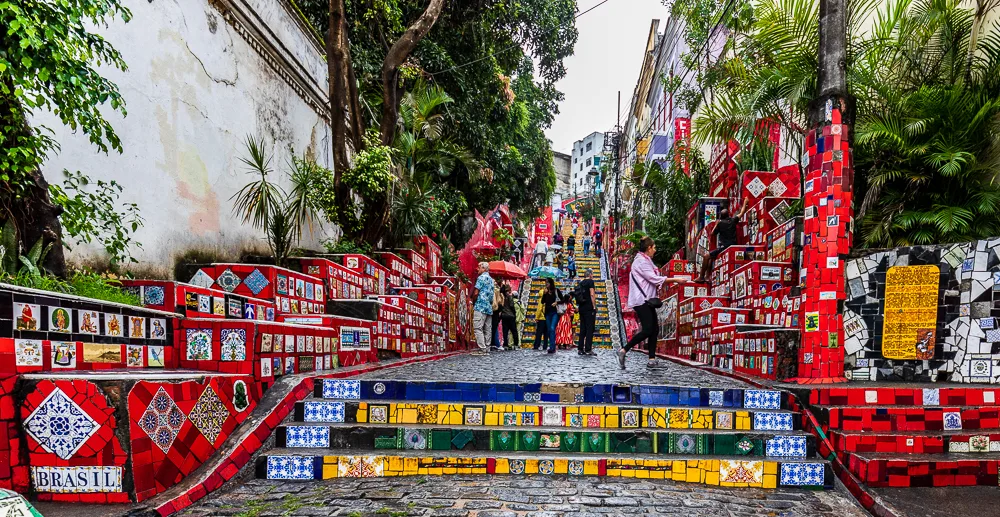
In Centro, the Escadaria Selarón, Mural Etnias, Parque das Ruínas, and Mosteiro de São Bento can all be part of the same circuit without requiring a high entrance fee. The idea here is to combine places for short visits instead of crossing the city for a single spot. The Mosteiro calls for a bit more calm, while the Escadaria Selarón and Mural Etnias work better as quick stops. Parque das Ruínas fits well when you want a break between one stretch and another. If the goal is to spend as little as possible, this part works best when combined with walking and public transportation, without trying to cram too much into the same period.
Parque Lage usually works well as an inexpensive break between more intense plans, especially when you want a pause for gardens and architecture without turning the day into a race. For those who prefer to save money on guided activities, free tours help fill Centro with context and walking movement; it’s worth checking the route beforehand, because the benefit is more in understanding the area than in “seeing more places” in the shortest time.
For a full day without straining your budget, a practical combination is to start at Escadaria Selarón, continue to Mural Etnias or Parque das Ruínas, have a simple lunch, and leave late afternoon for the beach or Arpoador. If the idea is a lighter program, Parque Lage in the morning and the beach late in the afternoon usually works better than trying to string together indoor attractions.
Family outings, rainy days, and travelers looking for more comfort
AquaRio, Museu do Amanhã, CCBB, and Maracanã help save days when the city calls for an indoor plan or one less subject to weather changes. AquaRio works well with children because the visit is indoors and has a pace that allows for pauses; Museu do Amanhã fits well when you want to combine architecture and content without depending on sunshine; CCBB usually works for those looking for a central outing, with a calmer visit; and Maracanã comes into play when the interest is football or when you want a closed-off outing that does not depend on the beachfront.

Lagoa Rodrigo de Freitas and Yup Star work better when the weather is stable, but without requiring the same preparation as a trail or viewpoint outing. Lagoa is useful for walking, cycling, or simply doing a lighter plan with children, a stroller, or a long break. The Ferris wheel works as a short outing and may appeal to those who want a view without physical effort. If the forecast is unstable, it is worth leaving these two for a part of the day when visibility is better and prioritizing the covered parts first.
For families, the choice is usually between a long-stay plan and an outing that fits well between meals and short transfers. AquaRio and Museu do Amanhã call for more continuous time; CCBB and Maracanã are usually easier to combine with the rest of the day; Lagoa helps break up the pace without buying a ticket; and Yup Star makes sense when you want a simple plan, without fatigue. If the trip includes small children, it usually works better to limit the number of stops and avoid days full of neighborhood changes.
On a rainy day, the practical order is to start with the indoor spaces and leave Lagoa for when the sky clears. If the trip has only a short window, choose a central attraction in a controlled environment; if there is a full day to spare, combine two covered programs along the same route and leave the open-air part for a safer window.
Nature, Trails and Views in Rio de Janeiro
Parque Nacional da Tijuca, Jardim Botânico, Pedra do Telégrafo, Morro Dois Irmãos, Parque Natural da Catacumba, Ilha da Gigoia, Pista Cláudio Coutinho, Baía de Guanabara, Pedra Bonita and Arpoador cover very different outdoor experience profiles in Rio. Some require physical preparation, others work as a light walk or a contemplative outing. The common point is that you need to choose the effort before choosing the place, because that changes the experience quite a bit.

For trails and climbs with more energy expenditure, Pedra do Telégrafo and Morro Dois Irmãos demand more willingness than a typical urban visit. Parque Nacional da Tijuca also falls into this group, but with the advantage of offering broader contact with the forest. Pedra Bonita pairs well with those who want views and a more athletic outing, especially if the idea includes hang gliding. Pista Cláudio Coutinho, on the other hand, is best for a flat walk, with less strain and more time to observe the surrounding landscape.
If the trip calls for a gentler pace, Jardim Botânico and Parque Natural da Catacumba work better. Ilha da Gigoia usually comes in as a water-based outing and a calmer transfer, useful when you want to step away from the most obvious route without turning the day into an adventure. The boat ride through Baía de Guanabara offers another way to read the city, through the shoreline and coastal views, while Arpoador makes a great end to the day for watching the sunset without requiring complex planning.
In practice, it’s worth matching the level of effort with the time of day and visibility. Trails and flights are more interesting with clear weather and good light; water-based programs and short walks are more forgiving when it comes to improvisation. If you want a single physical experience, choose between Pedra do Telégrafo, Morro Dois Irmãos or Pedra Bonita. If the idea is to fill a day with less impact, Jardim Botânico, Pista Cláudio Coutinho and Arpoador are better options.
Where to eat, drink, and go out at night in Rio de Janeiro
Lapa works well for anyone who wants to go out for drinks without complicating the rest of the day. The area brings together bars, live music venues, and samba circles, with an atmosphere that changes a lot between early evening and the early hours of the morning. If the idea is to have dinner before heading to a show, this is the city’s most obvious stretch; if you just want to have a drink and head back early, it also works, as long as you choose a quieter place and confirm the opening hours on the day.

Circo Voador comes in when the night calls for a show. It’s a more structured plan than a bar gathering, and it’s worth fitting in when you want live music with tickets and a defined schedule. In the same area, Fundição Progresso expands the options for those who want to alternate between performances and bars without straying far from the Lapa axis. For those who like to go out with some room for choice, this part of the city helps fill an entire night without relying on long trips.
In Vidigal, Bar da Laje works as an end-of-afternoon or evening plan, with a focus on the view and the informal setting. It’s not a place to improvise without checking whether it’s operating normally; since it’s a more sought-after plan at sunset and in the evening, it’s best to book or confirm beforehand. It fits best when you want to extend the outing with a stop for a drink and some time there, rather than just passing through quickly.
Confeitaria Colombo solves another part of the trip: coffee, a snack, or a break in a historic setting in the Centro. It’s not a nighttime spot, so it fits better into a daytime itinerary or the early afternoon, when you want to eat without resorting to a rushed meal. On the beaches, biscoito Globo appears as the easiest snack to fit in between a swim and a walk, useful when you want to spend little and keep going along the waterfront without sitting down for a full meal.
Frequently asked questions
What is the best area to stay in Rio de Janeiro for a first trip?
Zona Sul is usually the most practical base for a first trip, because it makes it easier to get to the beaches and several classic sightseeing spots. Centro, Lapa and Santa Teresa make more sense if the focus is culture, architecture and nightlife.
What should I do in Rio de Janeiro if I have only a few days?
For a first stay, it’s worth prioritizing Christ the Redeemer, Sugarloaf Mountain, Copacabana, Ipanema, Arpoador and a cultural outing in Centro. That way you get to know the beach, the views, the city and a bit of history without crossing Rio all the time.
Which attractions in Rio work well on a rainy day?
AquaRio, Museu do Amanhã, CCBB and Maracanã help keep the itinerary going on unstable days. These outings work best when you want indoor activities or ones less dependent on visibility.
How can I go to Christ the Redeemer without complicating the itinerary?
The most practical options are the authorized vans from Paineiras and the Corcovado train. Since demand can be high, it’s worth planning ahead so the outing doesn’t hold up the rest of the day.
Which free attractions are worth it in Rio?
Copacabana, Ipanema, Arpoador, Escadaria Selarón, Mural Etnias, Parque das Ruínas and Mosteiro de São Bento can make for a good low-cost itinerary. The idea is to combine nearby places and use walking and public transport when it makes sense.